Popular Post
Showing posts with label textile design. Show all posts

The (Low) Power and The Glory

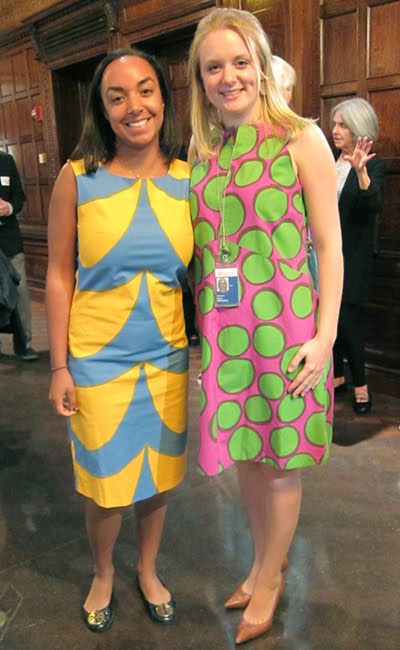
Media reform advocate, Pete Tridish (aka Petrie Dish), of Prometheus Radio Project, sartorially celebrates a hard won victory for community radio. The decade-long struggle for access to the low-power frequencies of the airwaves finally resolved with passage by Congress of the Local Community Radio Act, which was signed into law by President Obama early this year.

Ten years of curtailed access to the low-power FM spectrum had been based on claims by the powerful National Association of Broadcasters that LPFM broadcasting would interfere with their signal. A congressionally-ordered study later found those claims to be without merit. The repeal of these restrictions, opening the airwaves for hundreds of new community stations, will be felt especially in urban markets where the ban had its greatest impact.

Celebrating passage of the Local Community Radio Act was one of the inspirational high points of last weekend’s National Conference for Media Reform in Boston. This gathering of some 2,500 activists, journalists and scholars, organized by Free Press, covered a wide range of media reform issues.

As they say in LPFM circles, “Low Power to the People!”


Photos by Michael Scurato

Desktop Diaries, Digital Collages

BUTTERFLY & RAIN
Antique endpapers, 'Existentialism and Human Emotions', 'An Introduction to the Philosophy of Law', vintage butterfly-wing pendant, vintage camera, blue sign reflected in the rain.


In the summer of 2009, I started posting digital collages on a blog that I kept just for myself as a journal, called Desktop Diaries. They basically consisted of images that piled up on my computer’s desktop.
Description on the site:
As a graphic designer, artist, and collagist, my screen, at any given moment is a mélange of personal photos, assorted reference, spreadsheets, infographics, news sites and whatever essential item I might be watching on eBay. All sense of scale is lost as details can be huge, and sweeping vistas can be reduced to thumbnails. The collagist in me does not see the individual images, but rather the patchwork as a whole. And then I just have to grab that image. After all, these particular juxtapositions may never occur again. It’s not about Photoshop effects for me. I see the elements as I would pieces of found paper or ephemera--the edge of a window is just the digital equivalent of a torn edge of paper. The blurriness of an enlarged image is “found” texture. My desktop background with its floating folders often becomes an element as well. That is the origin

There haven’t been any new ones in a while--All My Eyes takes enough time. Here’s a selection of the over 50 posted.

IS MY TURBAN DISTURBIN’?
Ethnic woven textile, vintage quilt, K.O. Munson “sketch pad” pin-up calendar page, chemistry set, graffitied priority mail sticker


PYRITE EYES
Eye studies by Carrache, pyrite, vintage drawer liner in an antique dresser.


MOTH ON WHITE SHOULDERS
Vintage box of White Shoulders, moth on the screen at night, fresh-picked wild roses, vintage vase.


PIECE FULL & AMETHYST
Antique color chart, marbled endpaper of an old book, mod fabric, vintage textile swatch book, black and red scarf, combs, "Piece Full," book about japanese Boro textiles, mushroom textile, detail of a mod print slip, antique swatch book, print of an amethyst crystal.


MAX HUBER & BOOTS
Book cover, Max Huber Progetti Grafici 1936-1981; riding boots; Lichtenberg figure.


DARLING & BABIES
Pages from a German art calendar; package of plastic toy babies; title sequence from Darling, the 1965 John Schlesinger film with Julie Christie, Dirk Bogarde and Laurence Harvey; incredible ring with a flower of gemstones including turquoise, pearl, amethyst, and onyx.


HAMMERED & HAIRNET
Vestry seal of the Parish of St. Pancras, hairnet envelope, hammered silver modernist ashtray.


TAKE FIVE
Fragments of antique book bindings, TITA candy wrapper from Argentina, match book from Cafe Loup, card from Jenny Holtzer retrospective at the Whitney "GOOD DEEDS EVENTUALLY ARE REWARDED", diploma seal, ethnic textile, found handwritten type, Japanese cookbook, postcard of Gaudi staircase, vintage fabric, 3-d puzzle pieces illustration, wrought iron gate, Agam silk screen.


VENUS & DANSK
As soon as I scanned a page from an old collage journal (lower left quadrant: red foil, Venus de Milo), I just had to start combining it with other images--like the graphic candelabra by Dansk, and the rust cover of an old Russian book with a lovely little silhouette. The vertical stripes on the upper left is a photo of old painted paper.

'The World of Interiors' Covers


“I am not a library, I am not an archive.” That is the mantra I repeat as I struggle to let go of a stack of magazines or any other piece of paper I don’t have room for, or that I don’t “need.”

In the mid 1990s, I subscribed to UK-based The World of Interiors. I loved being surprised each month by the inventive design and quirky subject-matter, and I still cannot part with them. When I contemplate tossing them, from time to time, I flip “once more” only to find a piece of crucial information/inspiration. That’s all I need to call off the purge. Recently, when I thought, for a few minutes, that I could actually chuck them, these first two issues were the ones I thought I would keep just for the covers.

The bejeweled feet, above, gracing the March 2000 cover, are embroidered Moroccan slippers. How perfect they are on the staircase in the Tangier home belonging to antiques dealer and collector Christopher Gibbs.


The bold wool fabric, on the cover of the March 1998 issue, is not related to the longest, nor the most significant story in the issue. It is linked to a two-page story wedged into the listings section at the end of the book. Upcoming at a Sotheby’s auction, would be an archive of swatch books from the Calico Printers Association, a society of the many textile weavers and printers located during the 19th Century in Lanceshire’s Rossendale Valley. These amazing designs, which could easily be 1920s art deco, were actually produced in 1845.


I’m throwing in a few more of the covers from the late 1990s. These issues ran without cover lines, and in those days, the issues came wrapped, so there was no bar-code disturbance either.

June 1997


July 1998


October 1996


May 1997


December 1998

Knoll Printed Matter (Part I)


Easing into 2011 with some visual, gourmet comfort food.

Way in advance of spring, and the opening of the exhibition, Knoll Textiles, at the Bard Graduate Center on May 18, I trust these Herbert Matter-designed ads, posters, and catalogs for Knoll will whet your appetite for both (spring and the show).

Matter was a design consultant to Knoll from 1946-1966. The Swiss-born designer and photographer was a pioneer of photomontage, among other darkroom techniques and a master of merging type with image. His is the Knoll identity you know so well, that you recognize it without seeing a piece of furniture or reading a word of text.

I can’t say exactly when during the next few months I’ll be posting “Part II,” but I can safely predict that there will be one. The selection here represents only a fraction of Knolliana produced over the years. And that’s before we even get to the textiles ...


Sources: Another Design Blog, Yale Library

Design Research: Marimekko Mecca

The must-see design earlier this week at the Cooper Hewitt, was not on the walls, but on the staff and visitors. Vintage Marimekko was out in full force, as the National Design Museum celebrated this year’s Lifetime Achievement Award recipient, Jane Thompson, and the publication of the new book Design Research: The Store that Brought Modern Living to American Homes, by Thompson and Alexandra Lange.

Design Research was the legendary Cambridge, Massachusetts-based “General Store of Good Design” founded by architect Benjamin Thompson in 1953. D/R promoted simplicity, comfort, and affordable prices in home furnishings and accessories by importing well-crafted and designed products, chosen largely by Thonpson himself, from around the world. Perhaps the most notable of such imports were the hand-printed fabrics of the Finnish company, Marimekko.

Design Research became the lifestyle emporium of a generation, supplying not only the décor of an American design revolution, but the wardrobe as well. What better garb for the enlightened, soon-to-be liberated D/R female shopper than a bold, colorful, loose-fitting Marimekko frock?

The evening opened with a film-in-progress by Caroline Van Valkenburgh, It Wasn't Just a Dress, about women and their treasured Marimekko dresses. It’s a fascinating look at the iconic dresses, and their legacy.

Following the film was a panel moderated by the book's designer, Michael Bierut “Game Change in the Design of Retailing.” The program can be viewed here.


Filmmaker, Caroline Van Valkenburgh, right and one of the film's subjects.

Jane Thompson

Co-author Alexandra Lange