Popular Post
Showing posts with label japan. Show all posts

The ABCs of Fairy Dust


Very few stores are better at sensory overload than ABC Carpet & Home. Even when you think you cannot absorb one more dazzling display, pattern, color or texture, ABC’s “Visual Team” successfully manages to impose yet another layer of retinal stimulation.

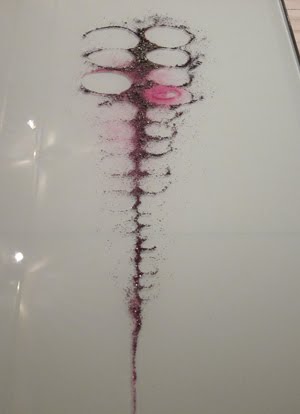
So it was at a recent event held at the store, that I found myself under the spell of what the ABC employees call “fairy dust.” It might appear as glittery graffiti on a mid-century étagère, or as carefully arranged dried buds peeking out from under a porcelain dinner plate. Even when the pixies take it up a notch for special events the effect remains subtle as the sparkles, petals and powders blend naturally with the flickering candles and the ambient surface reflections. After last week’s Apartment Therapy meetup, where Mira Nakashima-Yarnall, daughter of George Nakashima, talked about the work of Nakashima Studios, I had to take a closer look at these ethereal flourishes.


“Fairy dust” also graces the always otherworldly store windows.


Mira Nakashima-Yarnall, signing books, after her presentation.

Japan's Devastating Earthquake, 1923

Nyosen Hamada, Chased by the Fire, Drowned in the Water

The clothing was different, and there were horses being tossed, instead of cars, but the horror was eerily identical. The fires, the death, the leveled landscape, the injured, the homeless. Over 100,000 people died in the Kanto earthquake of 1923 and the tsunami and fires that followed. So much of Tokyo was destroyed, that the government considered moving the capital elsewhere.

I really didn't think that an art form as stylized and classical as a Japanese print, could come close to matching the power of the camera for a disaster of this magnitude. How wrong I was. Take a look at the faces, the gestures, the postures. After seeing the recent footage from Japan, these prints take on a reality that chilling.

This remarkable work of visual journalism was published in 1926 as a suite of 25 prints by nine artists, many of whom lost much in the earthquake. Each scene conveys a different facet of the anguish, terror and despair suffered by so many. The images and information here are from the site of print dealer, Artelino, where there is lots more to read about these prints and Japanese prints in general.

Apparently a full set of "Taisho Shinsai Gashu" (Pictures of Taisho Earthquake)" is quite rare, and this is where the tiny glimmer of hope is to be found. Far outweighing these scenes of devastation is the abundance of prints that recorded the rebuilding of Tokyo as a modern metropolis.

Nyosen Hamada, Tragedy of Horses


Shiun Kondo, The Tsunami Attacks at Suji Kotsubo after the Earthquake


Shiun Kondo, The Train Wreck around Oiso


Hakuhan Yawata, Around Gofukubashi Bridge on this Night


Unpo Takashima, Around Ueno


Unpo Takashima, Honjo


Kouyou Shibata, Around Fukagawa


Shiun Kondo, Mansei Bridge
Martial law was declared by the government after the earthquake, while order and essential services were restored. This is a police station on Mansei bridge.


Senrin Kirigaya, Burnt Ruins of Ginza Street
Ginza Street was a fashionable shopping district.


Kougai Noguchi, Nakabashi Hirokoji District


Kougai Noguchi, Narihira Tram Street
With a flattened landscape in the distance, a man operates a commuter wagon where street cars used to run.


Sengai Igawa, Refuge at Asakusa Kannon
I wonder if the flyers attached to the tree are for missing loved ones?


I'm tacking on these two prints (not from the series), of the raging fires.
This scene is by Kitazawa Rakuten, who is considered the father of Japanese manga. (via Three Steps Over Japan)

Fire near Asakusa Park. Animals from a show are on the loose and a twelve story building is destroyed. (via Vangobot)

Laying Needles to Rest

Broken and worn sewing needles will be lovingly and respectfully laid to rest in soft blocks of tofu throughout Japan today. Though hardly as popular as it once was, the annual ceremony known as Hari-kuyo (needle memorial service), dates back some 400 years. No sewing is done on this day, as all needle-workers (kimono-makers in particular), honor the soul and spirit of these important implements that served so well during their useful lives.

Photo by Michele Walker

teamuncoolfashion likes: nendo: 24 issey miyake shop - shibuya parco


Based on the concept of the japanese convenience store, 24 issey miyake shops combine
inexpensive prices, a large variety of colours and frequent changes in the product lineup.
nendo have created their latest store.

The miyake team wanted a new design concept for the 24 issey miyake shop in shibuya's
parco shopping complex, which includes a store that specially features miyake's new bilbao bag.

VIA

Miho Museum by I.M. Pei Harmonic with Nature in Japan


A few years back Gregg and I went to Kyoto Japan to buy Ikebana Baskets for a show we were curating at our Gallery in Santa Barbara. While there, even though we didn't have much time we made time to visit the Miho Museum. Off the beaten track, for sure, but so well worth the effort. The Museum is Southeast of Kyoto near the town of Shigaraki, in Shiga Prefecture. The Museum house the private collection of Mihoko Koyama the heiress to the Toyobo Textile business. The museum is named for her.


Miho Museum, LERA, I.M. Pei, architecture, design, Louvre, Kyoto, Japan, John Maienza, Gregg, Gregg Wilson, Maienza-Wilson, Ikebana Basket, Shangri-La,<br />Structural engineering, luxury travel, travel, eco luxury travel


I.M. Pei the Architect that Mihoko Koyama commissioned to design the museum referred to it as "Shangri-La" Evidently because hi design for the approach to the museum involves a long walkway on a bridge across a gorge and then through a tunnel through the hilly landscape. When one emerges out of the tunnel "you have arrived in "Shangri-La".  


Miho Museum, LERA, I.M. Pei, architecture, design, Louvre, Kyoto, Japan, John Maienza, Gregg, Gregg Wilson, Maienza-Wilson, Ikebana Basket, Shangri-La,<br />Structural engineering, luxury travel, travel, eco luxury travel


Miho Museum, LERA, I.M. Pei, architecture, design, Louvre, Kyoto, Japan, John Maienza, Gregg, Gregg Wilson, Maienza-Wilson, Ikebana Basket, Shangri-La,<br />Structural engineering, luxury travel, travel, eco luxury travel


Pei used the same French Limestone he used at his Louvre Pyramid in Paris. The structural engineers were LERA. Leslie E. Robertson Assoc. 75% of the museum's structure was built into the excavated mountain top. The earth was re filled over the structure essentially making most of the museum underground. The effect is that the forested hills are embracing the museum and that the whole environment is harmonious with nature.


Miho Museum, LERA, I.M. Pei, architecture, design, Louvre, Kyoto, Japan, John Maienza, Gregg, Gregg Wilson, Maienza-Wilson, Ikebana Basket, Shangri-La,<br />Structural engineering, luxury travel, travel, eco luxury travel


Miho Museum, LERA, I.M. Pei, architecture, design, Louvre, Kyoto, Japan, John Maienza, Gregg, Gregg Wilson, Maienza-Wilson, Ikebana Basket, Shangri-La,<br />Structural engineering, luxury travel, travel, eco luxury travel


Miho Museum, LERA, I.M. Pei, architecture, design, Louvre, Kyoto, Japan, John Maienza, Gregg, Gregg Wilson, Maienza-Wilson, Ikebana Basket, Shangri-La,<br />Structural engineering, luxury travel, travel, eco luxury travel


Shiseido at MIT


Shiseido, the Japanese cosmetics and skin care company, started as a Western-style pharmacy in 1872. In 1888 they became the first Japanese company to manufacture toothpaste, and in 1897 their cosmetics line launched with Eudermine, a scented skin toner still sold today.

Shiseido is one of the meticulously documented subjects of Visualizing Cultures, a program launched by MIT in 2002 to exploit the Web as a platform for image-driven scholarship. Of particular interest was the ability to study and present large quantities of previously inaccessible images.

The result is a website rich with visual and textual information. It’s kind of like a bottomless, scholarly, coffee table book, where you can wander as you please, through historic details and scores of hi-res color images.

As for the Shiseido archive, the past hundred plus years of Japanese history is all there. Industrialization, mass-market consumerism, urbanization, Western influences, modern warfare, and of course the enormous shift in the lives of women.

Here is just the tiniest taste of the ads, posters, and magazines you will find on the site


As a company focused on image and aesthetics, Shiseido was a constant innovator in product design, promotion, advertising and marketing. There were customer loyalty clubs, promotional giveaways, and magazines.

Shiseido cemented its chain store network’s shared corporate identity and values through the circulation of engaging public relations publications such as Shiseido Monthly (Shiseido Geppō) launched in 1924 (later renamed Shiseido Graph [1933 to 1937] and then Hanatsubaki), which was a free giveaway geared toward customers, and Chainstore (later renamed The Chainstore Research [1935 to 1939], The Chainstore [1938 to 1939], and then Shiseido Chainstore Alma Mater [1939 to 1941]), which was an in-house organ that communicated practical product and promotional information to chain store affiliates.


Above, newspaper ad from 1915.