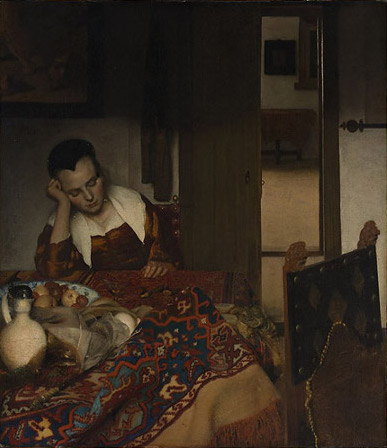
This is not news to anyone in New York with an appetite and the ability to leave their apartments: antique is in, marked by an abundance of speakeasy-style bars and rustic-tinged restaurants: see Freeman's, Marlow and Sons, Hotel Delmano, The Richardson, Walter Foods, etc. Here a predilection for old stuff in interior design is matched at the same time by a drive towards craft in food production. There are several other places in New York culture where old-timey reigns as well. My point here is not to announce several well-observed recent trends, but to group them together in an attempt to analyze their origins and consequences. It's not hard, for example, to connect the dots from the restaurant world to the rise of old-world bakeries and butcheries, to the growing interest in locally-grown, organic food products - the rise of the so-called locavore, who out of both health and environmental interests makes locally-grown products an essential priority. Dovetailing in with locavore-ism is a broader trend towards craft and self-reliance - homemade, hand-constructed, DIY, the sorts of projects found in books like "The Urban Homestead: Your Guide to Self-Sufficient Living In the Heart of the City"

The contemporary value of such drives towards urban farming, local foods, and general self-reliance cannot be underestimated in light of urgent environmental and global economic problems, such as those brought to light in the riveting documentary Collapse: through his analysis of the looming deadine of peak oil production, Michael Ruppert, the engaging, slightly paranoiac expert, effectively makes the case that "urban homesteading" is more than a youthful trend, it represents the possibility for humans to continue to survive once oil production and the modern life which it sustained begins to irrevocably decline. Old-timey or traditional food production is thus in fact quite cutting-edge - it will undoubtedly play a major factor in the restructuring of society which will most likely occur in the wake of peak oil.
You'll find the old-timey vibe on city streets as well these days, thanks to an abundance of beards, solid footwear, tweeds and flannels. Sidewalkers in Brooklyn can bear a passing resemblance to The Band:

Interestingly, The Band's look in this 1969 photo is already retro, a re-do of cowboy-era duds, and their folk-rock sound at the time already a throwback in an era of plugged-in psychedelia. A recent NYT article highlights the expansion of influence by nineteenth-century styles from restaurants to men's fashion: "This Just In From the 1890s." On a further musical note, it should be pointed out that, as is often the case, music was in on the old-timey thing before restaurants figured it out: witness the blossoming of recent subgenres like "freak folk" and the "New Weird America." Before all these guys, though, there was Animal Collective, whose band name is only one example of their ingenuity, a prescient forerunner of cultural trends towards both the rural and the communal. "Sun Will Shine" by Akron Family epitomizes both these qualities, a gospely, twangy folk-rock tune expands into a choral-voiced stomper, drawing out the blues chords in a grand expansion reminiscent of Spiritualized. Akron Family specializes in shambolic folk jamborees, and they're not alone: bands that emphasize collectivity are all the rage, as are group-vocals and afro-inflected tribal beats. In this way, "Animal Collective" isn't only a particular band name, it's almost a description for a kind of band that has emerged in the past five-ten years.
Akron Family - Sun Will Shine

What do these trends, musical, ecological, and gastronomic, share in common? We might detect in them a distrust or weariness with modernity, with the excesses of industrial society and the alienated life that it perpetuates. This is prominent in discourse on contemporary food production: the large-scale industrial farming complex, documented for example in the excellent Food, Inc. wreaks havoc not only on the earth and our biological life, but our existential life as well, obliterating a sense of connectedness. The ground beef that appears in the burger I consume has traveled an invisible path, the result of an obscured production process. In all the antique restaurants, farmer's markets, beards and folk-tunes one can sense an almost a prelapsarian hearkening for a simpler time, a simpler life, a life connected to its own roots, to the past and the traditions that engendered it.
But why now? Why has this urge become so manifest? It's been in the works, you might say, ever since Sept 11, 2001. If you buy the logic behind Time Magazine's latest cover story, the decade that will close at the end of this year represents nothing less than the 'dimming' of the American dream: "Bookended by 9/11 at the start and a financial wipeout at the end, the first 10 years of this century will very likely go down as the most dispiriting and disillusioning decade Americans have lived through in the post–World War II era." The tradition trend, you can say, is in part a widespread reaction to this passing decade of American decline, an attempt to hide-out among the nostalgic ruins of the past from the bleak forecasts of the future. Such a hiding-out was acutely felt in the wake of last year's economic collapse, when at the time the highest-grossing movie in the country was "Paul Blart: Mall Cop," a comedy in which, fittingly enough,the lead character is a fallen authority figure, an incompetent, arrogant boob in the seat of power tasked with protecting the public. The American public flooded the theaters for a bit of cinematic escapism, only to get their loser president thrust once again in their faces.

Worth noting here is a concomitant but distinctly separate trend, the rise of cuteness, whose trajectory was recently expertly traced by Jim Windolf in an article for Vanity Fair, "Addicted to Cute." Here Windolf points out that cuteness exploded in Japanese culture after the end of WWII, a result of a widespread feeling of the loss of political supremacy. The same causality, Windolf argues, is at work in the rise of cuteness in the US since 2001: our entitled sense of global hegemony shattered by the attacks, we in part sought refuge in innocent, calming visions of lolcats and other adorable internet memes.

In this historical context, what cute and old-timey share as cultural values is that they mark a feeling of the loss of authority. In her essay "What Is Authority?" from the late fifties, Hannah Arendt called attention to the broad collapse of traditional authority in the twentieth-century. This collapse led, she argued, to the generation of new forms of domination, most notably the strains of fascist and socialist totalitarianism. Authority, Arendt claims, takes its strength from being beyond argument. Authority doesn't try to persuade you, it doesn't try to violently force you, it just holds an almost mythic sway over your actions and obedience. You follow authority just because. It's not hard to see how a cultural hankering for tradition might result from a certain sense of a recent loss of American supremacy in particular and a decline in political authority in general. Tradition, Arendt says, is central to maintaining authority, because authority is all about the continuing legitimacy of the past. In the wake of the hollowing out of the American dream of the past ten years, American culture began to re-organize itself, like cells in an organism working to close over a wound.
Oddly enough, I would argue that the cute trend in part reflects the same need for authority. Cuteness affects you prior to your ability to judge it. Cuteness does not persuade or force, cuteness acts on you in a primal, biological way. You cannot evaluate or criticize it, and its effect is immediate. To experience a cute thing is to take a momentary respite from the adult world of responsibilities and decision-making: neither you nor it can be criticized or taken to task. Cuteness provides a similar escape from the demands of independent, critical thinking that submission to authority does. While the tradition trend can be seen as a reaction to contemporary circumstances, it is neither inherently good or bad, productive or harmful. Like any trend, the tradition trend contains a mixture of ideological and progressive elements. In part, it is undoubtedly an escape, a national version of going to see Paul Blart for ten years. The past remembered is never the past taken place: memory, whether personal or cultural, is always a stand-in, a cheap substitute for real events. The "good old days" evoked by Henry Public and other such places were never really that good, as Merle Haggard once sang:
While recently discussing these matters, a friend remarked that an acquaintance of hers, an internet food writer of some renown, had been sharing with her dreams of moving from New York and starting a farm. An inevitable consequence, it would seem, of a rural-obsessed metropolis: move out to the sticks! wear Hunter boots! raise vegetables while wearing a beard! Pure heaven. As Merle's song points out, such images neatly leave out all the thankless toil, labor and dedication characteristic of rural life which spurred the drive for modern technological convenience in the first place. On the other hand, the correlate drives towards local produce and self-reliance generated by a cultural interest in the lifestyles of the past will be invaluable in the near future. The American dream, insofar as it has been shored up by sixty years of geopolitical arrogance and the unshakeable dogma of free-market capitalism, has proven untenable, and hopefully the trend towards tradition will provide the grounds not for regressing to an old America, but for thinking it anew, out of the possibilities left still half-buried in the past.
Finally, there's a great Scott Walker tune, from Tilt, whose title encapsulates the beards, tweeds and speakeasies of New York 2009: "Farmer in the City." This stirring and unsettling tune is carried by a protagonist, an outsider moving across a disorienting landscape, who feels like a farmer in the city, unfamiliar with his surroundings. If the tradition trend imagines us as happy together in the past, planting crops and singing in a big group, Walker imagines the solitary farmer alone in the future. In this context it's a reminder that the wilderness is not only the rural idyll we might see on the wall of a rustic-themed pub in Williamsburg, it is also the historical future which we must venture into in order to solve the problems of today, a wilderness ultimately without the comforts of a mythic past or anthropomorphic feline.
Scott Walker - Farmer in the City