Popular Post
Showing posts with label JCB. Show all posts

Bess in Winter

.
Another blast of cold weather, with a slight possibility of snow has me feeling cold. I love cold weather in all honesty, but I have found myself adding a layer here and there. It must be my aching bones. My niece gave me a wool challis stole for Christmas and it is close by for a blanketing effect when needed.


 Horst photograph


 How did the likes of Bess of Hardwick manage to stay warm?


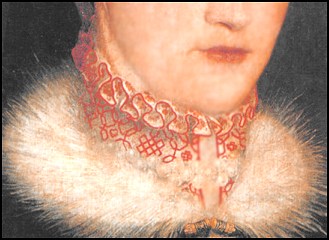
 Aside from the wearing of fur, (at left)- as a young woman in heavy robes beautifully tipped in fur. Bess as Lady Cavendish, painted by a follower of Eworth, c. 1557. She wears fine jewelry & her fine clothes include a linen smock worked with  scarlet, and-( at r.) as the formidable Countess of Shroesbury in ermine, no less.


A favored color?


Bess always had a fire in her bedchamber at Hardwick hall and kept the room well insulated against draughts and winter chills. "Those large windows, which were so splendid architecturally,, made the house particularly cold and draughty in the winter, especially perched as it was on a hilltop."  (excerpted from Mary S Lovell's Bess of Hardwick)


Just imagine a Tudor morning and a driving snow without.

Hardwick Hall
photograph John Gay


Rather than the opulent silks and velvets which feature in the guestrooms, her bed was  a great scarlet-caparisoned tester bed hung with warm bed-curtains of finely woven scarlet wool. The window curtains were also scarlet. And a second pair of bedhangings were kept to be used over the scarlet ones in exceptionally cold weather; when these were all fastened round her bed, it must have been cosy to the point of stuffiness. (Mary Lovell)


I immediately thought of the sumptuous bed & room of David Hicks, though the heavy coverings of Bess's scarlets are hardly matched here, I think Hicks captures an out of time quality in this room.


Though I could easily envision Bess redecorating the David Hicks room by adding her fine handwork to tapestries all about the room-something like the ones she would have had a hand in. She was a master at the needle.


Appliquéed heraldic panel, Hardwick Hall, 16th C.
image from here


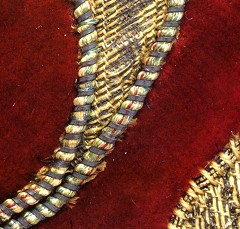
Appliquéed flowers and bands from a piece at Hardwick Hall, 16th C.
from here


Born in 1527, Bess learned her excellent skills and management of household from her mother and her aunt, creating a grand yet comfortable world  from the time of her marriage to Sir William Cavendish in 1547 until her death. As Lady of Chatsworth and from all of her subsequent titles, she employed embroiderers, seamstresses & lace makers to create the enormously detailed hangings of Hardwick Hall that can still be seen today.


Europa and the Bull
 (all needlework images from an Elizabethan Inheritance the Hardwick Hall Textiles)


an unknown woman by Marcus Gheeraerts 
 costume is modeled after "Virgo Persica" (the dress of Persian maiden) 
from Boissard's Habitus Variarum Orbis Gentium


Bess's aging bones evidently felt the cold a good deal, for in her chamber were three coverlets to hang across the two windows and the doors in winter months. Eight warm rugs protected her unshod feet, two great tapestries fifteen foot deep, 'with personages and forest work', hung against the walls. And in addition to the 'featherbed', bolster and pillows, there were twelve warm blankets.(Lovell)


from an Elizabethan Inheritance the Hardwick Hall Textiles
above & in detail, below


Typical (below) are the Hardwick Hall bedchambers (see National Trust photographs below) that Bess shunned in favor of her scarlet woolen saturated rooms.


Hardwick Hall
Early-eighteenth-century bed in the Green Velvet Room. ©NTPL/Nadia Mackenzie


Hardwick Hall
Bed from about 1740 in the Cut Velvet Bedroom. ©NTPL/Nadia Mackenzie


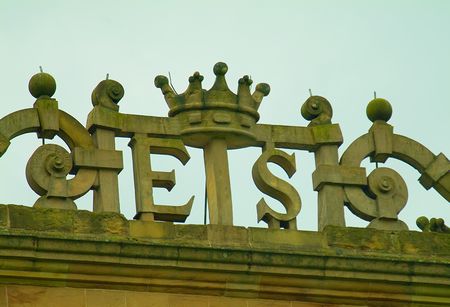
Bess died on February 13, 1608, probably age 80 & what a remarkable life. Sadly she would not have seen the spring beauty of Hardwick Hall but gazed on its winter blanket of snow. The scarlet wrapped haven against the cold left to be bathed in dower black.


'I assure You, there is No Lady in this Land that I better Love & Like.'
-Queen Elizabeth I about Bess of Hardwick
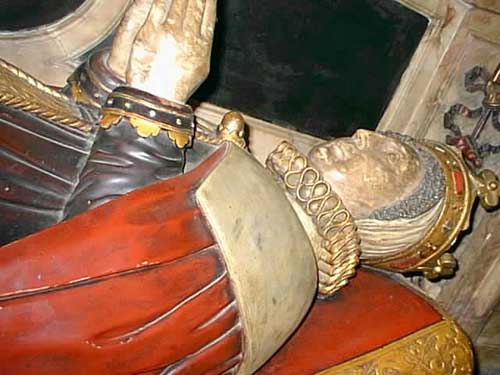

and I think Yes, to the scarlet.


Resources used for this post:

Emile de Bruijn of the National Trust here


stop at  Janet Blyberg's JCB to read about Hardwick Hall here

photographs of Hardwick Hall here

find a grave photograph here


.

what they're READING now

.

I checked back in with my reader's from the Summer Reading Series. Here's where they are and what they said-

An Aesthete's Lament


The one I am reading right now? I just finished (last night) "Rage for Fame," a biography of Clare Boothe Luce ... The next book I shall read is "Conversation Pieces" by Mario Praz ...


theHouse of Beauty and Culture

There is a growing stack (In House, More is More - Tony Duquette, and the new book on David Hicks among them) that I have not even had a chance to look at. This is a very bad habit. I still haven't yet read Pat Montadon's book (2007) or Kevin Sessum's Mississippi Sissy (2007). And, the books I ordered last week (Divas on Screen being among those) are due in on Tuesday! But I digress, in answer to your question I am currently reading: Madeleine Vionnet by Pamela Golbin (new), Wallace Neff and the Grand Houses of the Golden State by Diane Kanner (2005), and Mother of Sorrows by Richard McCann (2005)
And undoubtedly next week I will look at the bookcase with all my unread books and think, but, there is nothing to read! Oh, the caprice of it all.


JCB
Oh, I am never reading just one book! Right now: Angela Davis-Gardner, Plum Wine.

"A mystery that unfolds as beautifully, delicately, and ceremoniously as a lotus blossom. One of the most memorable novels I have read in many years." —Lee Smith, author of The Last Girls

&
Nathaniel Hawthorne, The Blithedale Romance. I am organizing my book week for next month...and will finally write that little piece on seasonal reading you suggested (inspired by the Paris Review interviews).le style et la matiereBooks? You do mean books, don't you? The Moonstone by Wilkie Collins (rereading - inspired by a certain LA post); The Art of Arts by Anita Albus profound reflections on painting, art, symbols of human life through an examination of Dutch art and thinkers of various cultures; Decorating is Fun by Dorothy Draper (I understand Jennifer Boles' inspiration; they are both light and breezy but get down to important brass tacks in an original way); Ghost Stories by Edith Wharton (seasonal yes, but I'd never read these and they are worth reading at anytime)... Mrs BlandingsI am reading the Cecil Beaton biography by Hugo Vickers &Emily Evans Eerdmann’s Classic English Design and Antiques. Can’t wait to see what else is on everyone’s bedside tables!& MeIf nothing else-checking back in with all makes me know I am not alone. As HOBAC says of his growing stack-And undoubtedly next week I will look at the bookcase with all my unread books and think, but, there is nothing to read! Oh, the caprice of it all.Currently reading- Clarence John Laughlin Prophet Without Honor by A.J. Meek, along with reviewing his published photography books. When I want to switch it up- I go to Ottoline Morrell: Life on the Grand Scale by Miranda Seymour.On my groaning bedside table, next up- Journey Into The Mind's Eye by Lesley Blanch and The House of Life by Mario Praz. Both books recommended by AAL and the Lesley Blanch book by Lucindaville. On the book's jacket, Blanch writes "My book is not altogether autobiography, nor altogether travel or history either. You will just have to invent a new category." In the fiction category-Wolf Hall by Hilary Mantel the 2009 Booker Prize winner.


.

William Styron:Child of the South

.


Writing the things one reads- Telling the story, Explaining the story, Switching it up, Words moved about for a fresh take and new look- and then sometime just the story you read.-The story can not be touched.

It is just right this way.


Photograph by Hans Namuth

William Styron, a child of the South, of Virginia, a Pulitzer Prize winning writer, poet in prose. Some things are beautiful to return to- even within its dark shadows.


Brandon c. 1765


excerpt from William Styron's Architectural Digest Children of a Brief Sunshine, first published in 1984

(all italics Styron)

If the accident of birth caused you to spend most of your early life, as I did, on what is known as the Virginia historic peninsula, you were apt to grow up with a ponderous sense of the American past... Part of my spirit was always mysteriously drawn to the James River mansions. They spoke to me in a secret, exciting way that the other landmarks could never speak, and I still consider them among the state’s truly captivating attractions.


the Jame River
from the AD photographs


Westover and Brandon. Shirley and Carter’s Grove. There are other fine Colonial structures in the Tidewater, but these four remain the exemplars of the noble species of dwelling that the early planters built on the banks of the James, creating, from native brick and timber, likenesses of the country houses of England they had left behind, but in each case, out of some quirky genius, imparting to the whole an individuality that remains arrestingly American.
The mansions have of course undergone much restoration since the mid-18th century, when they were built. (William Byrd’s Westover, perhaps the most splendid of the group, was badly mutilated by fire during the Civil War.) But one of the remarkable things about these houses is the way they have escaped the look of having been prettified by the embalmer’s hand. Although they are linked in spirit by their obviously Georgian origins, part of the charm of each lies in its almost defiant distinctiveness—Shirley, with its absence of wings, having a lofty solidity, in contrast, say, to the dignified horizontal expansiveness of Brandon and its rectangular wings attached to the center by connecting passageways. Each is unique, and a surprise.


Brandon staircase


There are perhaps few habitations anywhere that ever so successfully fused aesthetic delightfulness with unabashed commerce. The plantation houses were really the headquarters for complex business enterprises. Their situation on the river happened not primarily because of the ingratiating view, but because the James was the means whereby each estate’s golden harvest of tobacco was shipped back to the insatiable pipe smokers and snuff dippers of England and the Continent. What strikes one, then, is that the homes—created by gentlemen for whom profit was a paramount concern—are so fastidious yet so sensuous in their elegance, so satisfying in terms of all those components that make up the nearly perfect human abode. And all of this took place on the breast of a raw and primitive continent whose often violent settlement began not many years before.
How easy the temptation must have been to erect something tacky and utilitarian and to make one’s getaway; the banks of the waterways of the earth have been littered by exploiters’ shameless eyesores. But Virginia planters like William Byrd and his fellow proprietors, entrepreneurial though they were, made up a rare breed whose sense of environment was subtle and demanding. We know from the records they left that they responded with passion to the music of Purcell and Lully, to the Eclogues and Georgics of Virgil; why should they not be determined that their surroundings be imbued with equal serenity and refinement?
Among other things, these fog-dampened Britons were plainly intoxicated with the flowering of Virginia’s lush and sun-drenched countryside. And so what impressed me as a boy, perhaps unconsciously, impresses me now with logic and force; the harmonious connection between the mansions and their natural surroundings, each of them seeming to grow like an essential ornament in a landscape of huge, hovering shade trees, boxwood-and-rose-scented gardens, and a sumptuous lawn undulating to the river’s edge. Two hundred and fifty years later this mingling of elements has a flowing integrity and authenticity. Also, humanity and wit.
Look for humanity and wit almost everywhere in one of the James River mansions. In the great downstairs hall, the visitor will see how two doors facing each other allowed guests to arrive from opposite directions: by way of a tree-lined carriage road or, for people coming by barge or boat, across the lawn from the bank of the river. In the solitude of that barely civilized wilderness, guests were welcome and fussed over, and they came incessantly. Isolation made hospitality more than a ritual: It was part of a hungry need for communion, and the splendidly paneled rooms that give off the main hall saw manic activity: dancing and reading aloud; parlor games; music played on spinet and mandolin and harpsichord; gossip, flirtation and seduction; card games; much drinking of local applejack and fine Bordeaux wine around fireplaces that were everywhere and fueled from inexhaustible sources of Tidewater timber. Early on, Virginia developed a serious cuisine. At tables in the big dining room, the food—usually supplied from outside cookhouses—was served to the household and to the endless stream of visitors in orgiastic plenty that still makes one marvel..One discordant presence was usually forgotten, or overlooked, even then. ..
As the present-day visitor looks out across the tidy beds of flowers bordered by boxwood and traversed by brick walls, his gaze may linger on the outbuildings (or the spot where they once stood), and they too will seem to fall symmetrically into place. These smaller buildings—servants’ quarters, cookhouse, tannery and smokehouse, carpenter’s shop, all decently contrived of honest and workmanlike construction—were, of course, the demesne of the black slaves, whose toil had been essential to the creation and success of the mansions, and continued to assure their perpetuation. The “people,” as they were so often called, had been generally treated with care and kindness, so it is understandable that the planters suffered vexation over their common plight and cursed heaven for their predicament. However, not knowing what else to do, they allowed the problem to pass into the hands of later generations, who resolved the matter in one of the most murderous wars ever fought. Meanwhile, the beautiful mansions endured, and still endure.


all plantation photographs from William Styron's AD article Children of a Brief Sunshine (here)

all Photography by Hans Namuth (here)

JCB "southern views" a post on the plantation

Sources
read more about STYRON
Duke here
his obituary here
from PBS here
his writing here
Paris Review interview here


JCB- the natural order- A Summer Reading List

janet~jcb on a jaunt to Thomas Jefferson's Poplar Forest

"The human mind is not capable of grasping the Universe. We are like a little child entering a huge library. The walls are covered to the ceilings with books in many different tongues. The child knows that someone must have written these books. It does not know who or how. It does not understand the languages in which they are written. But the child notes a definite plan in the arrangement of books--a mysterious order which it does not comprehend, but only dimly suspects."

albert einstein


What Books are on your Summer reading list?


The Seamstress by Frances De Pontes Peebles


Shanghai Girls by Lisa See


The Thirteenth Tale by Diane Setterfield


The Brother Gardeners: Botany, Empire and the Birth of an Obsession by Andrea Wulf


a page from Linneaus


…and finish reading Bess of Hardwick: Empire Builder by Mary Lovell


Is there one book you honestly don’t expect to get to? Why?

hmmm…I am going for gold! I have high expectations.


Where do you read and when? Does the genre you are reading dictate the place you read- in other words, Do you take just any old book to bed?


I read a lot when I travel, which is frequently. But, of course the best place to read is in bed because it always feels like such a luxury…especially with a hardcover book.


What does your nightstand look like? or your side of the bed, floor, chair!


jcb's book stack


I usually have at least three or four books on my nightstand, or various chairs around the apartment.


What is you all time Favorite Book for its sense of place?


Oh, hands down: The Far Pavilions by M.M. Kaye. Really, who can resist a sweeping epic novel set in colonial India?


What is your favorite Genre?
Why?
What is your most recent purchase in this category?


I love fiction, especially mysteries. But, I am also addicted to art books and cook books. My most recent purchases in the latter two categories include the exhibition catalogue, Pompeii and the Roman Villa, and the cookbook, Jamie Oliver at Home (in fact, they just arrived in the same box!)


bookcase order JCB

What about Books you are reading for a second or third time?
Why?
Any disappointments on second reading?


Until recently, I would have said I rarely reread books (the exceptions being Wuthering Heights by Emily Brontë, and Rebecca by Daphne du Maurier). However, I have lately rediscovered some other old favorites (thanks in part to Heather over at The Overdecorated Bookcase This includes A.S. Byatt, whose prose is so beautiful, you can read it again and again and discover something new each time—and Mary Stewart, whose mysteries I devoured as a teenager. Upon second reading, I am surprised at how wonderfully sophisticated Stewart’s stories and heroines are.


REBECCA! makes its fourth appearance in the Summer Reading Series. Architect Design is a Rebecca lover as is An Aesthete's Lament (from the comment made), and of course it is a wonderful read- a wonderful Movie- I would classify it as my favorite -certainly my Vintage favorite. I have checked the Overdecorated Bookcase and it is a wonderful source for readers.


Book covers can be art- Do you have a favorite cover in your stacks?


The book is my latest acquisition: A 1932 reprint of "The Formal Garden In England," by Reginald Blomfield (1892) with illustrations by F. Inigo Thomas.


This is an absolutely gorgeous book cover- I love the old ones too.


When it comes to books I consider to be art, I am a purist—a sucker for classic design, thick quality paper, and old-fashioned book construction (i.e. letterpress, sewn bindings, cloth covers). I like there to be both a visual and tactile quality to a book.

Going out on a limb here –define LIBRARY in the nontraditional sense?

Call me a Luddite, but when it comes to libraries, I am a traditionalist at heart. The word library comes from the Latin librārium, meaning “bookcase”—and I just can’t get away from that! While I am a huge fan of the internet and digital technology, a true library is a place where you can lose yourself in the stacks.


IS YOUR library or stack OUT of ORDER? Find rhyme and reason this Summer- tell us How you sort your books at home? Get HELP from a NEAT Book Notes Journal- pages to fill with recommended reads, reading notes, favorite quotes, and books you have borrowed or lent- Fill us in...and help is on the way.